Machine Learning Techniques Used for the Identification of Sociodemographic Factors Associated with Cancer: Systematic Literature Review

Background: Cancer remains one of the foremost global causes of mortality, with nearly 10 million deaths recorded by 2020. As incidence rates rise, there is a growing interest in leveraging machine learning (ML) to enhance prediction, diagnosis, and treatment strategies. Despite these advancements, insufficient attention has been directed towards the integration of sociodemographic variables, which are crucial determinants of health equity, into ML models in oncology. This review, investigates how machine learning techniques have been used to identify patterns of predictive association between sociodemographic factors and cancer-related outcomes. Specifically, it seeks to map current research endeavours by detailing the types of algorithms employed, the sociodemographic variables examined, and the validation methodologies utilized. We conducted a systematic literature review in accordance with the PRISMA guidelines. Searches were executed across seven databases, focusing on primary studies employing machine learning to investigate the relationship between sociodemographic characteristics and cancer-related outcomes. The search strategy was informed by the PICO framework, and a set of predefined inclusion criteria was utilized to screen the studies. The methodological quality of each included paper was assessed. Out of the 328 records examined, 19 satisfied the inclusion criteria. The majority of studies employed supervised machine learning techniques, with Random Forest and XGBoost being the most commonly utilized. Frequently analysed variables include age, sex, education level, income, and geographic location. Cross-validation is the predominant method for evaluating model performance. Nevertheless, the integration of clinical and sociodemographic data is limited, and efforts toward external validation are infrequent. Machine learning (ML) holds significant potential for discerning patterns associated with the social determinants of cancer. Nevertheless, research in this domain remains fragmented and inconsistent. Future investigations should prioritize the integration of contextual factors, enhance model transparency, and bolster external validation. These measures are crucial for the development of more
equitable, generalizable, and actionable ML applications in cancer care.

This study will be published in https://www.jmir.org

The state of practice about security in telemedicine systems in Chile: An exploratory study

Information security within telemedicine systems is essential to advancing the digital transformation of healthcare. Telemedicine encompasses diverse modalities, including teleconsultation, telehealth, and remote patient monitoring, all of which depend on digital platforms, secure communication networks, and internet-connected devices. Although these systems have progressed in aligning with information security standards and regulations, there remains a shortage of comprehensive, practice-oriented studies evaluating which aspects of security are effectively addressed and which remain insufficiently managed, particularly within the Chilean context. This study aims to examine how effectively telemedicine systems in Chile address the core security attributes of confidentiality, availability, and integrity. Data were analysed from an evaluation tool designed to assess the quality of telemedicine systems in Chile. Over a six-year period, 25 telemedicine systems from different providers were assessed, and an in-depth examination of how companies manage key information security sub-characteristics within their systems was undertaken. The findings indicate that 52% of telemedicine systems optimally implement cryptographic techniques to protect confidentiality. In contrast, 44% lack robust strategies for adapting to, recovering from, and mitigating security-related incidents. Fault tolerance mechanisms are frequently integrated to minimise service disruption caused by system failures. However, the prioritisation of data integrity varies: while some companies treat it as a critical requirement, others assign it limited importance. This study offers an understanding of the security priorities and practices adopted by telemedicine providers. It highlights a prevailing tendency to prioritise security measures over usability, underscoring the need for a balanced approach that safeguards patient information while supporting efficient clinical workflows.

This study will published in https://medinform.jmir.org

Exploring Security Controls in Health Information Systems Using CodeBERT

Health information systems (HISs) are integral in enhancing clinical operations and improving patient care. To fulfill this role, these systems require a comprehensive design capable of addressing essential health quality attributes such as security. This design, typically embodied in software architecture, must incorporate secure design decisions that adhere to established software security policies and guidelines. Such design decisions are frequently represented by security control (also known as security tactics). Despite the significance of implementing and developing security control to protect information within HISs, there is a paucity of empirical studies that examine which security control are actually used in these systems. This gap significantly hinders the reuse and acceleration of secure design decisions within the software architecture of a system. In this paper, we report a study aimed at identifying security controls in health software projects by utilizing a CodeBERT model. We applied the trained model to 10 open-source projects related to HISs, and classified the identified security tactics.
The findings suggest that the security controls identified in HISs predominantly focus on security-by-design prevention strategies, whereas detection and recovery strategies remain largely unaddressed in the context of attacks. Our study represents an initial effort to elucidate which secure design decisions are prioritized in the development of HISs.

This research will be presented in International Conference of the Chilean Computer Science Society (SCCC)

Exploring Machine Learning and Explainable Artificial Intelligence Models to Identify Potential Hidden Risk Factors in Breast Cancer Data

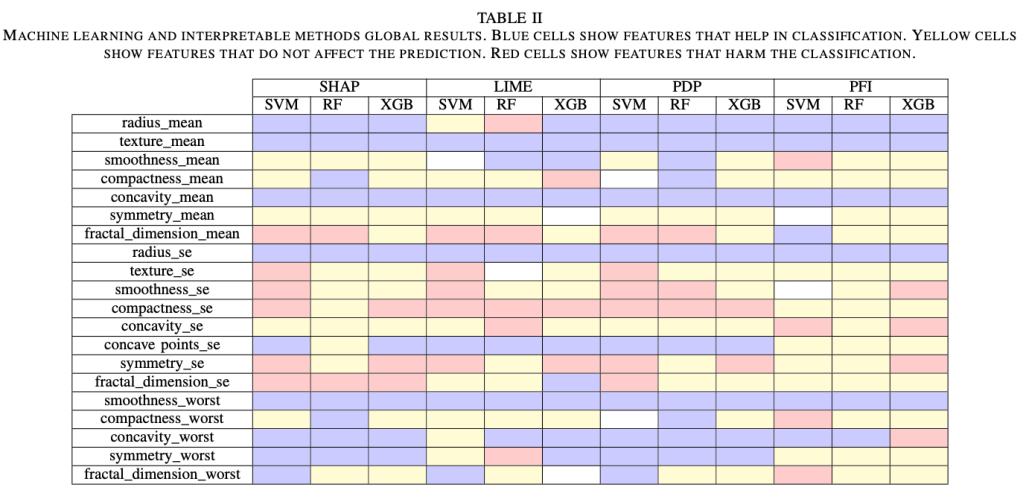
Hidden risk factors in cancer are elements that contribute to the development or progression of cancer but are not immediately apparent or easily detectable. These factors may encompass genetic alterations, environmental exposure to carcinogens, and socio-demographic variables. Although early detection strategies exist to identify hidden risk factors at more treatable stages of cancer, there is limited discussion on the application of artificial intelligence models to support the identification of these hidden risk factors. This paper presents a study focused on the identification of potential hidden risk factors in cancer through the use of machine learning and explainable artificial intelligence techniques.
We analyzed a breast cancer database and employed support vector machine, random forest, and extreme gradient boosting to classify the data. Subsequently, we utilized four explainable artificial intelligence techniques to examine the positive, neutral, and negative features of the dataset. The findings of our study suggest that explainable artificial intelligence facilitates the identification of positive features within the dataset that are considered potential hidden risk factors for breast cancer.
These results can significantly contribute to the enhancement and support of cancer-screening strategies.

This research will be presented in International Conference of the Chilean Computer Science Society (SCCC)

Machine Learning Techniques in Microservices: A Systematic Mapping

Microservices architectural design has become increasingly popular due to the enhanced scalability, flexibility, and maintainability of large and complex applications. Machine learning (ML) has emerged as a powerful tool in microservices deployment and management. Although ML techniques have been useful for building microservices-based system architectures, the current literature does not provide clear guidance on which ML techniques developers of these systems might use. This research describes the design and results of a systematic mapping study to identify the ML techniques used in the building of microservices-based systems. The review yielded 193 articles, of which 34 primary studies were selected. Key findings are: (i) Monitoring, diagnostics and observability (MDO) and Resource orchestration and management (ROM) are the most used domains; (ii) Deep Learning (DL) and Unsupervised Learning (UL) are the most used techniques; (iii) Proposed solutions validated through evaluative research dominate the field; (iv) Case studies and experiments are the main empirical strategies; and (v) Public data sets are limited. This effort will enable developers to effectively address the refinement and improvement of software designs using ML methods.

This research will be presented in International Conference of the Chilean Computer Science Society (SCCC)

Learning and Predicting Competitive Tumor-Immune-Normal Cell Dynamics Using Physics-Informed Neural Networks

Modeling tumor progression and immune response is a key challenge in computational oncology. Traditional ODE-based models offer insights into interactions among cancerous, healthy, and immune cells, but often rely on ideal assumptions and dense data. In this research we explored the use of Physics-Informed Neural Networks (PINNs) to learn and predict the behavior of a nonlinear system modeling tumor-immune-normal dynamics. By embedding biological equations into the learning process, PINNs can train on sparse or noisy data while respecting domain constraints. We assess their performance under varying data availability, showing that moderate training data enables accurate reconstruction and extrapolation, whereas excessive data may induce localized errors. These findings suggest that PINNs are promising tools for biomedical modeling, with potential applications in personalized simulation and treatment planning.

This research will be presented in International Conference of the Chilean Computer Science Society (SCCC)

Security Discussions in Quantum Software Projects on GitHub

Quantum software engineering is an emerging field that leverages quantum computing and software development to address contemporary computational challenges. A significant concern in this domain is security, which has become a critical issue in quantum software engineering. Despite advances in quantum computing security, there is a lack of empirical evidence examining the primary security concerns of developers within the context of quantum software engineering. This paper presents a study that identifies, describes, and analyzes topics discussed by developers regarding open and closed issues of quantum software projects hosted on GitHub. Of the 18 identified projects, 2,264 filtered open and closed issues were obtained, of which 294 (13\%) were related to security. Using the Latent Dirichlet Allocation algorithm, 15 topics were identified. Furthermore, we identified the key security concerns that developers addressed in the issues, the majority of which were oriented towards code failure, noise and modular validation. This study serves as a precedent for a practical analysis of the identification and characterization of security topics, as well as the initial insights into security design decisions that developers discuss in quantum software projects.

This study will be published in the Journal of Systems and Software

Defining a Modifiability Scenario for Quantum Software

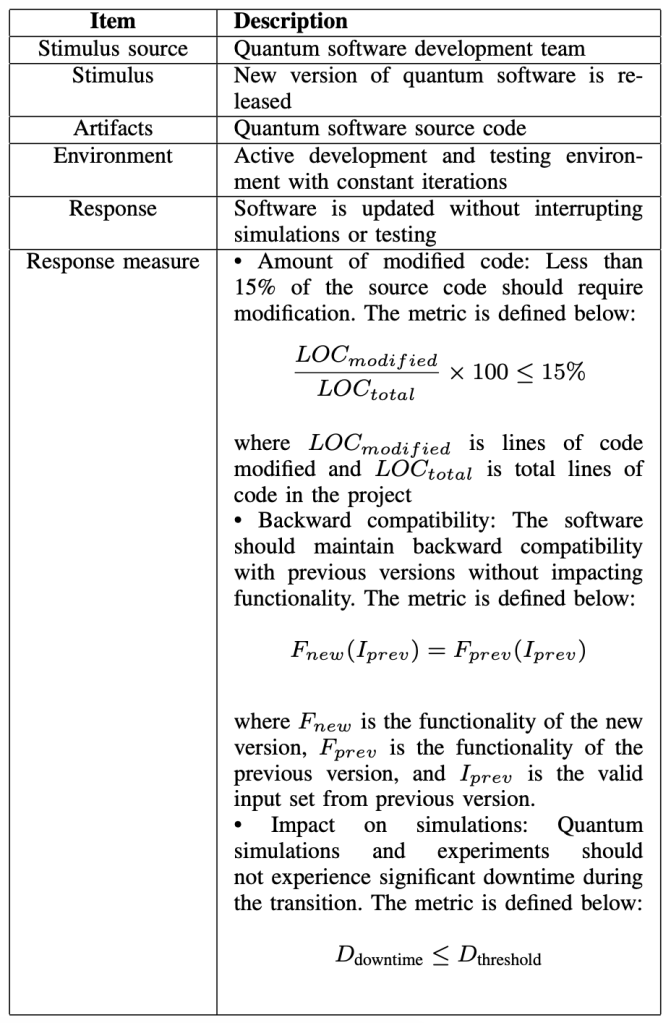
Quantum software engineering aims to establish methodologies, tools, and frameworks to support the development of functional and maintainable quantum applications. A critical aspect within this domain is the maintainability of quantum software, which pertains to the system’s capacity for modification, correction, or evolution over time. Modifiability is particularly significant as it encompasses mechanisms that enable software to be altered effectively and efficiently without introducing defects or compromising quality. Despite its importance, there has been limited discussion on addressing modifiability in quantum software. Moreover, there is little information on studies that translate maintainability concerns into specific modifiability scenarios. In this paper, we present our investigation about defining a modifiability scenario for quantum software, characterized by sources of stimuli, stimuli, software artifacts related to modifiability, environment, responses to the stimuli, and measures of those responses. We examined the release and version histories of 18 quantum software projects to extract data from each version. Preliminary findings outline the development of a concrete modifiability scenario for quantum software that facilitate the implementation of the defined responses within the modifiability scenario in quantum software.

This study will be published in IEEE Xplore and presented at CLEI 2025

Framework to Support Students in Defining DevOpsTechnology Stacks

DevOps is an approach to automated software development and deployment that combines development and operations, with the goal of improving collaboration between teams to optimize the software lifecycle processes, from planning and development to testing, deployment, and monitoring. Despite being an innovative approach, DevOps presents a significant challenge for students in understanding and implementing software development projects. This challenge includes understanding the problem to the solution abstraction that contemplates the design, implementation, and automation of the software development process. This study proposes and evaluates a methodological framework to support students in defining DevOps-oriented technology stacks.
The framework combines software architecture and software engineering practices that collectively provide a learning approach based on design decision-making and selection of technologies, frameworks, and tools. We evaluated the framework in two iterations of a capstone course, using a case study that considered the implementation of a DevOps stack on (i) a pre-existing system and (ii) a system from scratch. Results show that students who implemented a DevOps-oriented stack on systems developed from scratch were successful, but those who implemented it on a pre-existing system confronted challenges in configuration management and system flexibility. The proposed framework facilitates the pedagogical experience of implementing DevOps in software development projects, thus rendering it beneficial for students.

This study will be published in IEEE Xplore and presented at CLEI 2025

Using implementation science to develop and deploy an oncology electronic health record

The management of oncology clinical processes involves the efficient management of data using electronic clinical records to effectively monitor and treat oncology patients. As the process of treating and monitoring cancer patients involves multiple stakeholders with differing perspectives, the implementation and deployment of oncology clinical registries represent a significant challenge. In this study, we address this complexity by employing a technique that helps translate implementation strategies into requirement identification methods, which are subsequently disseminated throughout the implementation and deployment phases of health information systems. We applied this technique to develop an electronic health record for the national cancer plan in Chile. The findings indicate that six implementation strategies are essential to addressing stakeholder needs, as well as three requirement identification techniques to describe the underlying problem. Furthermore, a study conducted with 27 stakeholders revealed that the perception of the oncology electronic clinical record has considerable acceptance in three critical functionalities related to the clinical process of oncology patient management. The use of implementation science strategies provides an alternative approach to understanding the underlying problem that stakeholders face when they require healthcare technologies.

Link of the paper